Showing posts with label learn to photograph the aurora. Show all posts

Thursday, July 9, 2015

Tips and techniques for photographing the northern lights

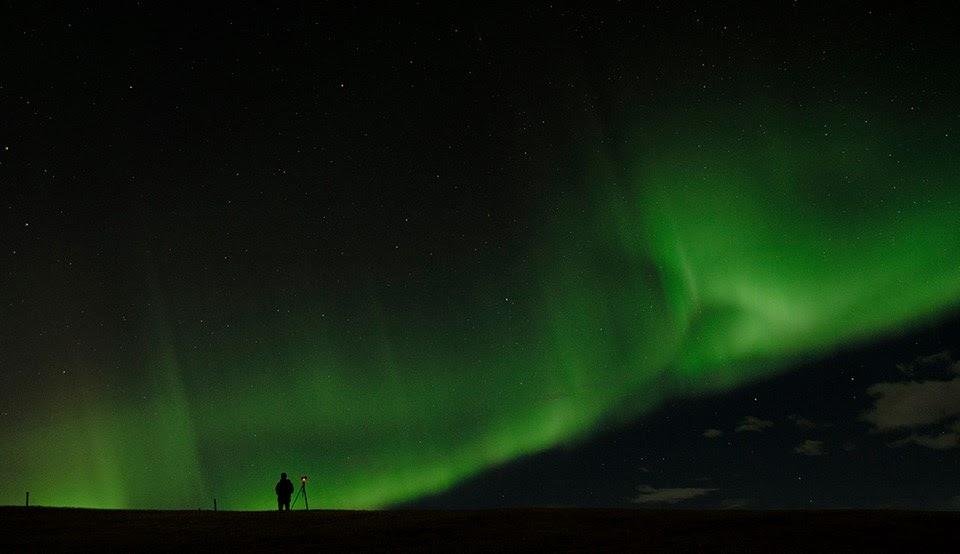
The spectacle known as the northern lights is something I promise you will never forget, and if you are prepared to photograph them, you will be able come home and share your photos with friends and family.

The Aurora Borealis occurs in the Northern hemisphere.  It can be experienced in locations further from the Arctic circles, but to improve your chances of seeing them you need to spend some time on or near the activity zones. Iceland, Norway, Yukon and Alaska are just some of the places famous for the Aurora Borealis in the Northern hemisphere, but I find the best places to be are right in my back yard, northern Canada.


HOW TO PHOTOGRAPH NORTHERN LIGHTS
A good sturdy tripod. I use the Manfrotto Manfrotto 057C4 Tripod with the 057 Magnesium Ball Head with Q5 Quick Release
A remote trigger so you don't have to touch the camera.
The camera should be a 35mm SLR camera or a DSLR with manual focus (set to just shy of "infinity"), which works well for Northern Lights photography. I use one of two full frame cameras. A Nikon D800e and a Nikon D3.
You should also consider a camera that has BULB mode so you can manually control exposure times. That will allow you to vary the length of the exposure as the lights curl in the night sky.
Digital cameras will need to have to be manually adjustable focus with ISO ranges up to 1600 or 3200.
A wide-angle zoom lens, f2.8 (or lower numbers), will give great results photographing the Northern Lights. I shoot with a Nikkor 14-24mm f2.8, a Sigma 35mm f1.4 and a 24-70mm f2.8.
If you have a prime lens (with fixed focal length) for your camera, bring it. My Sigma 35mm is sharp as a tack and produces great images.

TAKING A PICTURE:
You generally will not be able to take good pictures of the Northern Lights with short exposure times. Good exposure times for this are 20-40 seconds per picture (the tripod will help you eliminate shaking of the camera - you can't hold the camera by hand.) Now, this can be adjusted depending on the brightness of the lights, the aperture you are using and the ISO you set your digital camera to.
I have taken photos of the northern lights with ISO as high as 6400, with apertures as much as 1.4 and shutter speeds that range from 3 seconds to 15 seconds.
A sample exposure time for ISO 800 with an aperture of f/2.8 would be 10 to 20 seconds depending on the brightness of the lights.

LOCATIONS & TIMES:
It can be hard to predict the Northern Lights so you may be in for a few hours of waiting during a cold night.
The best times generally are after midnight and range from October to the end of April each year. In Canada, the two best places I have found are near Yellowknife and near Whitehorse.
But remember, You should head out of the city and get away from light pollution to obtain maximum quality of photos.

TIPS:
1.Batteries don't last as long in cold nights. Bring spare batteries and keep them inside your pockets against the warmth of your body.
2.Try lots of different exposure settings; night photography is challenging. Test your setup first.
3.Include a part of the landscape to make the photos more attractive and as a visual reference for size.
4.Do not use any filters, as they tend to distort the beauty of the Northern Lights and degrade the image.
5.Turn on "noise reduction" and the white balance can be set between 3200K to 5000K or set to auto on digital cameras.

TECHNIQUES
To increase your chance of a successful aurora hunt, you need to be aware of the weather.  If it is cloudy, your chances of seeing the aurora grow weaker.  If you have a clear sky you have a much better chance.

You also need to check the space weather for the northern lights forecast. Please not, even if the space weather forecast is weak, it may still be worth venturing out if you are up north in the areas that I previously mentioned… Iceland, Norway, Alaska, Northwest Territories and the Yukon.
So you are in an active zone and you have a clear sky and the space weather is a bit uncertain. You can increase your chances again by eliminating light pollution.

The moon can also work against you.  If you are planning a trip to an Aurora zone, try to book it as I do when there is a new moon.

Get your camera set up so that it is easy to handle. Using a flash light make sure your cable is connected, your lens is set just short of infinity and the camera is level to the ground. Then turn off the flash light and let your eyes adjust to the darkness.

You can use the waiting time constructively.  You can practice with your bulb and find a good composition.  Set your camera to f/2.8 (or as wide as possible) iso 800 and take some test shots for 15 to 30 seconds.  Do this in all directions but mainly due north (Aurora Borealis).  You may start to see a green hue on your pictures near the horizon. This is a good sign and this is the part of the sky you need to watch.

As the aurora starts to get brighter you need to start adjusting your settings accordingly.  Start by bringing down your iso to get crisper images.

Important note… Always check the brightness of your image on the histogram and never rely on the camera preview screen.  Your eyes have adjusted to the dark so an underexposed image will look fine – until you get it home! Speaking from experience… the back lit LCD screen in the dark makes photos look brighter than they actually are.

If the whole sky explodes and the Aurora casts a shadow, you need to be quick to adjust your exposure times.  The best Aurora shots occur during these brief moments.  A faster shutter of 4 to 10 seconds will preserve some of the details of the display.

The added bonus… Sometimes you cannot avoid star trails if you don't trust high ISO and you lens stops at f/4, you might be exposing for 2 minutes with a weak aurora.  Generally it is preferred to expose for less than 30 seconds to prevent noticeable star trails.  Stars begin to move over 20 seconds… so if you want fixed stars you will have to increase ISO to keep exposure times under 20 seconds… but, sometimes star movement adds an element to the images you take.

Workshops and Tours to see the northern lights in Canada.

Trips to the Yukon neat Whitehorse


Monday, April 6, 2015

Northern Lights Photo Workshop


Join Kevin Pepper and Chris Pepper for this workshop in Canada's north.

Wk #1 from September 19, 2016 to September 24, 2016
Wk #2 from September 25, 2016 to September 30, 2016

Cost: $3595 Canadian

Day 1 - Arrival day. As you arrive from home you will be picked up at the airport and brought to the hotel. Here we will gather for a group dinner to get to know each other and go over our planned route for the week.

As you arrive you will have free time until our group dinner at the hotel. After dinner you will have the option of heading out for a possible aurora sighting away from the city.... or stay in and relax for our busy week ahead.

Day 2 -  Our day begins with a short trip to Cameron Falls. Located just 46 km from Yellowknife. A scenic 20-minute hike from the parking lot takes you through stands of fall colors provided by aspen, spruce and jack pine, where you're likely to spot whiskey jacks and nighthawks.

As we near Cameron Falls, the trail climbs over outcrops of sedimentary rock. Stairs span some sections, but several steep areas remain. At the viewpoint, you can admire the Falls framed in a palate of fall colors and explore the side-trails.

Walking 250 meters northeast will bring you to a bridge above the Falls that offers access into the rest of Hidden Lake Park. The park has been kept in its natural state, and there are no trails past this point.... just us and nature. Trail Length: 1.2 km.

At night we will drive out where minimal light pollution exists and plan to watch the aurora from one of many lake side positions that we have identified as great aurora viewing locations.

Day 3 - The Northern Frontier - Stretching from the north and east shores of Great Slave Lake, east to the Barrenlands and northwest to Great Bear Lake, Northern Frontier is adventure country. Featuring some of the oldest exposed rock in the world, studded with countless lakes and rivers, some as yet unnamed, it’s a paddler’s paradise in summer and early fall. Here are the headwaters of legendary wilderness canoeing rivers, flowing north and east - the Coppermine, the Thelon - and shorter rivers, both wild and tame, draining south into Great Slave Lake.

In a landscape of sandy eskers and glacial moraine the caribou seem to suddenly appear and vanish just as quickly. Tiny plants carpet the land and as we descend on the territory they will have morphed to a ruby red tapestry under foot in August and September.

Today we will travel to the East Arm. The scenery is on a grand scale, virtually untouched since the glaciers retreated. Marvel at the 600 meter cliffs that drop into quiet bays. On a sunny autumn day, the East Arm reveals its colours - from greys and yellows, reds to brilliant pinks, marine blues and turquoise.

Great Slave Lake's East Arm is a world class scenic and geological wonder. Spectacular cliffs drop into the tenth largest lake in the world. The scenery is primeval, the result of glaciation in North America and a clearly visible fault in the earth's crust. The future National Park includes an historic 50 km trail to the Barrenlands called Pike's Portag

At night we will remain in the area and prepare to photograph the stunning terrain we photographed during the day, at night... this time hopefully with northern lights or star trails and the milky way...

Day 4 - They say that Wildlife viewing on the highways is free. Black bear and foxes peer out from the forest. Wood bison, the larger northern relative of the plains bison, are making a comeback near Fort Providence and Fort Liard.. and we often encounter them on our highways – when they do, we will stop and let them cross the road in their own time and enjoy the scenery through your lens. We will drive through an area where the Mackenzie Herd of Northern Bison are ranging from 2000 to 3000 buffalo. The Mackenzie Bison Sanctuary is home to the first successful bison relocation program recorded in North America.

As we travel the Frontier Highway,one of the best ways to view the Mackenzie Herd;  the bison are often grazing along the side of the highway. Sometimes resting on the highway and almost always crossing the highway.

Moose and woodland caribou live in the woods and wetlands all along our highways. Bald eagles and tall, dusty-grey sandhill cranes are two easily spotted species spending the summer in the Dehcho area, together with ducks, gulls and terns, warblers and other songbirds.

But these common sightings only the supporting cast to our waterfall and fall colors we will encounter on the western delta of Great Slave Lake.

Our return back to the hotel will consist of a watch for the aurora... and if it appears, we will stop and photograph it.

Day 5 - The Great Slave Lake area attracts hundreds of thousands of migrating waterfowl to its islands, bays, marshes and wetlands. This area combines parts of all four recognized North American flyways – Atlantic, Mississippi, Central and Pacific for birds that migrate to the Arctic each summer.

North of Yellowknife, Behchoko and Whati, geese, ducks and swans nest and breed each summer. The North Arm is popular with gulls, terns, red-breasted mergansers and mallards. Loons, terns and jaegers populate the islands at the mouth of Yellowknife Bay. Large numbers of bald eagles make their headquarters between Yellowknife and the East Arm.

But lets not forget the rolling vistas of fall colors that will carpet the landscape and make the forests come alive. The photo opportunities will surround you at every turn.

After our return to the hotel for dinner, we will once again depart for our own aurora watch over some of the remote calm lakes away from the light pollution... and if the skies do not dance in color and sing to us, there is always the opportunity for some star trail photography and long exposure photography.

Day 6 - One more stroll during the golden hour to see the fall colors outside of Yellowknife. This morning we will go to Niven Lake Trail. The (2 km) Niven Lake Trail circles a small and productive lagoon which features some of the best bird watching in Yellowknife, as well as glimpses of muskrats and the occasional beaver. There is a variety of ground surfaces here, from muskeg, to forest to rock, and many scenic fall color viewpoints with interpretive signage to inform you what you are photographing.

Plan your departure for after 3pm and we will drop you off at the airport around 1 pm.

Please note: We do our best to stay on schedule; however there is the possibility of delays due to factors beyond our control. We do our best to ensure you see all advertised tours within the time frame of the trip.

Included... airport pick up and drop off, transportation, Meals from dinner on day one to breakfast on day six, entrance fees, guides, photography guidance

Not Included... anything not listed as included, trip insurance, alcohol, laundry, items of personal nature.
 
 
See our other Canadian Workshops Here - http://northof49photography.com/photo-workshops/

Friday, April 3, 2015

Yukon, Canada Photo Tour


This trip offers a close up view of life in the Yukon for photographers and non photographers alike. Step back in time; this tour will take you on historic trails used by many trappers over the years. You will learn the basics of mushing and form a close relationship with your dogs when we’re setting off into the wilderness, exploring the pristine winter wonder land of the Yukon through our lenses. If we’re lucky we may see the amazingly beautiful Aurora Borealis dancing in the sky, or see some of Yukon's abundant wildlife.

Come up north for your adventure of a lifetime and you’ll go home with many tall stories, great photos and happy memories.

Workshop #1 is from March 16, 2016 to March 23, 2016
Workshop #2 is from March 23, 2016 to March 30, 2016

Price of Workshop:

$3975CAD for a maximum of 10 people

Single Supplement is $350CAD

Deposit Required: $750CAD and the balance due before January 15th, 2015.

Trip Itinerary

Arrival should be the day before the trip to ensure that we are ready to be picked up at 10am on day one.


Day 1 Saturday / Wednesday:

We pick you up at 10.00 AM in the hotel lobby. We can do some last minute shopping and pick up any items missing from the packing list. Then we drive to the ranch, 20 km South of Whitehorse, where you’ll be outfitted with expedition clothing. Enjoy the hot lunch and then you are introduced to your 4-legged companions for the week. You’ll learn the basics of dog care, checking their feet and shoulders, dog massage. Get familiar with the parts of the sled and sledding. Then you harness your team, hook them up and off you go for your very first run! When we return, and you’re finished with taking care of the dogs, you can enjoy the sauna, have a shower, enjoy a hot dinner and cozy up by the fire, keeping an eye on the sky for the aurora.

 
Day 2

While the morning sun hits the magnificent mountains we will be out taking photos and then come back and enjoy our breakfast in the lodge and plan the day ahead. We say good morning to our new furry friends and make sure they are fed, watered and happy before harnessing them. Today we plan to cover approx. 35 km in distance, driving towards secluded Jackson Lake. The only sounds on the way are the runners gliding over the snow, the breath of the working dogs and your words of encouragement. On this day you start to know each dog's personality. They will learn to trust you and you to trust them, and you’ll form a bond that only man and dog can understand. Overnight at the Lodge and again keep our eye on the sky for the aurora.

 
Day 3

Today your team will bring you east of the ranch. As we are heading onto an old abandoned mining road and gain in elevation. Enjoy the pristine landscape of snowy mountains nestling the lake in its valley. Keep an eye out for wildlife, and your camera ready - you never know what you might see! Return to the lodge for the night. After you have taken care of the dogs, you can put your feet up by the fire, recounting your adventures with others while we keep an eye out for the aurora in the sky.

 
Day 4

This day takes us towards beautiful Bonneville Lakes, west of the ranch. The trails are narrower here with some challenging ups and downs. The scenery and photo opportunities are breathtaking. Part of this trip we are above tree line and easily cover 20-30 km. In harmony with the running rhythm of your team you will enjoy nature like you have never experienced it before.

Tonight we will again keep an eye out for the aurora dancing above the mountains and tree line.

 
Day 5

We head out into the pristine wilderness for 3 days of winter camping at our wall tent camp at Dry Creek. The silence of this area seeps into your soul as you journey farther into the amazing landscape. Enjoy the crisp freshness of the day and don't forget to take photos! Curl up at night by the wood stove for a cozy sleep in the wall tents... but if the aurora is dancing, we will be outside taking photos of the night sky.

 
Day 6

At dawn we will be out taking photos before we enjoy a hearty camp breakfast in our wall tent kitchen. From the camp, weather permitting, we will make a run to the top of the mountain to Ptarmigan Flats. Keep your eyes open for this beautiful white bird, while sledding on miles of windblown hill tops. Over night at the wall tent camp with hopes that the aurora is in the skies at night.


Day 7

During our run back towards the lodge, take in the rugged landscape through your lens one last time and breathe the fresh clean air. As you mush over the clean white snow, listen one last time to the quiet whoosh of the runners and the soft panting of the dogs. This is the stuff dreams are made of; these are memories that stay forever. Don’t forget to take pictures! Back at the lodge lunch is served. Then it’s time to say goodbye to your new found furry friends as we head to Whitehorse for your last night in the Gold Rush Inn. Upon arrival in Whitehorse you will receive your musher diploma.

 
Day 8

The Whitehorse shuttle service van brings you to the airport for your southbound flight.


Trip Includes

•Transfer from Whitehorse to ranch.

•Last night accommodation in Whitehorse ( 1 night double room).

•Accommodation in cabins (4 or 5 nights double room) or wood heated tent outpost camps (2 or 3 nights group accommodation).

•All meals including non-alcoholic beverages, except dinner and breakfast in Whitehorse.

•Use of personal sled and 3 to 6 Huskies.

•Musher Diploma.

•Winter Boots (all other equipment can be rented for a fee if you wish).


Trip Excludes

•Alcoholic beverages 

•Meals in restaurants

•All expenses of personal nature.

•Trip cancellation & medical insurance: We strongly recommend you purchase adequate insurance coverage at the time of booking. Your policy should cover injury, illness or death, trip cancellation, emergency medical, search & rescue, flight accident, travel accident, loss of baggage and personal effects.

Trip Notes

•Average temperatures at this time of winter are between -2° and - 24° Celsius (28 to -31 Fahrenheit). We ask you to bring adequate clothing to withstand these temperatures.

•A pack list is available!

•This Dog sledding adventure is a challenging but relaxed fun trip!

•We supply you with the best equipment possible and teach you all the important aspects of mushing;

•To participate you must be healthy, enjoy working with dogs and have a good team spirit,

•dog sledding is a comparable physical activity to cross-country skiing, so you should be in relatively good physical shape.

•Depending on the dynamics of the group this tour may include a 3rd tent night and the itinerary may change slightly;

•The camps have no power or telephone, showers are of basic gravity fed nature and not available in tent camp, shower and sauna at Lodge;

•We do recommend that you arrive the day before your tour. Pre and Post nights in the hotel can be booked for you upon request.

Contact us if you would like more information, or you want to book. To contact us please click here to visit our contact us page. http://northof49photography.com/contact-us/
See all our Canadian Photo Tours Here - http://northof49photography.com/photo-workshops/