Showing posts with label what can I photograph in Canada. Show all posts

Tuesday, June 9, 2015

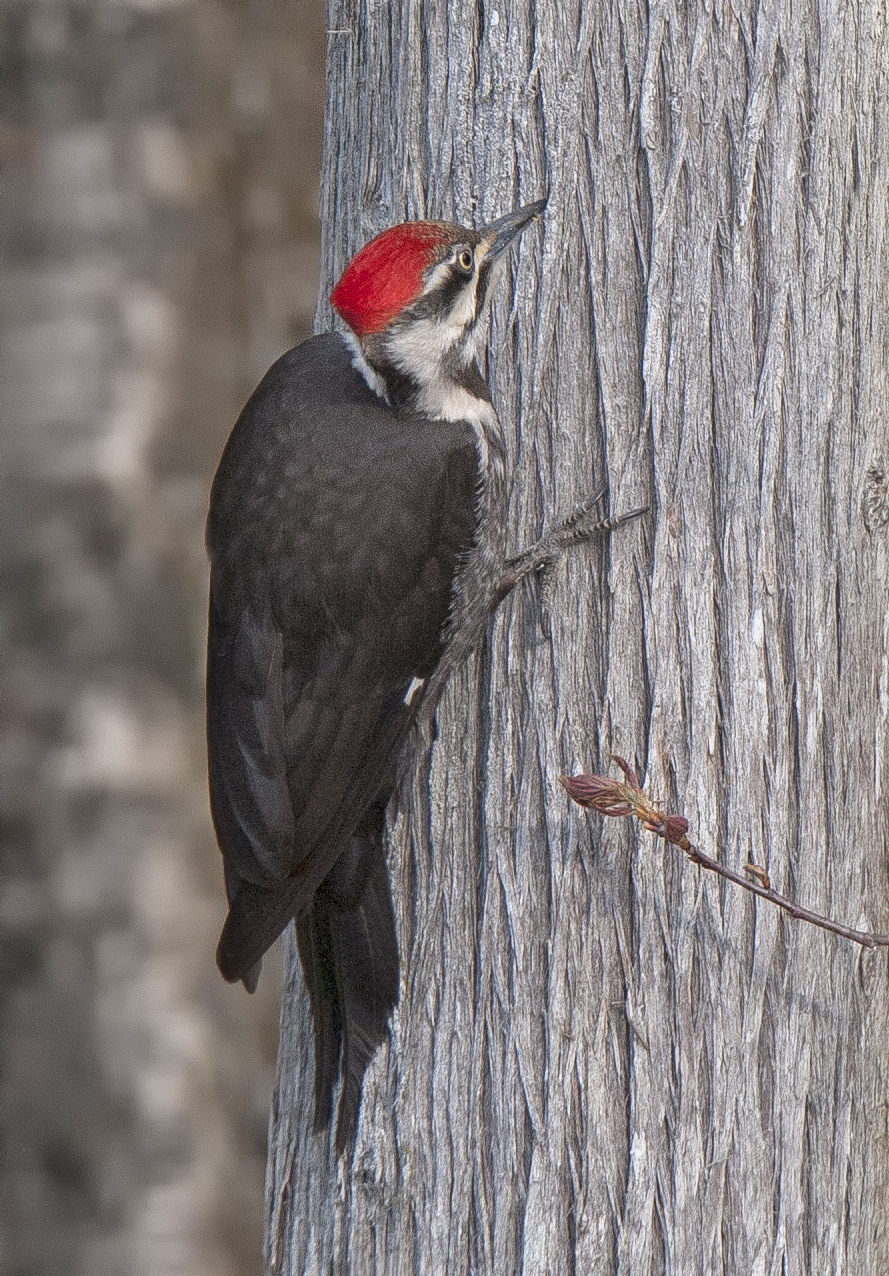
Canadian Bird Species - Pileated Woodpecker

The Pileated Woodpecker is a very large North American woodpecker, roughly crow-sized, inhabiting deciduous forests in eastern North America, the Great Lakes, the boreal forests of Canada, and parts of the Pacific coast. It is also the largest woodpecker in North America.

Adults are 40 to 49 cm (16 to 19 in) long, span 66 to 75 cm (26 to 30 in) across the wings and weigh 250 to 400 g (8.8 to 14.1 oz), with an average weight of 300 g (11 oz). Each wing measures 21.4 to 25.3 cm (8.4 to 10.0 in), the tail measures 14 to 17.4 cm (5.5 to 6.9 in), the bill is 4.1–6 cm (1.6–2.4 in) and the tarsus measures 3.1–3.8 cm (1.2–1.5 in).

They are mainly black with a red crest, and have a white line down the sides of the throat. They show white on the wings in flight. The flight of these birds is strong and direct but has an undulating quality, similar to the relatively unique flight-style of all woodpeckers. Adult males have a red line from the bill to the throat, in adult females these are black.

These birds mainly eat insects, especially carpenter ants and wood-boring beetle larvae. They also eat fruits, nuts, and berries, including poison ivy berries. Pileated Woodpeckers will often chip out large and roughly rectangular holes in trees while searching out insects, especially ant galleries.[4] They also will lap up ants by reaching with their long tongue into crevices. They are self-assured on the vertical surfaces of large trees but can seem awkward while feeding on small branches and vines. Pileated woodpeckers may also forage on or near the ground, especially around fallen, dead trees, which can contain a smorgasbord of insect life. They may forage around the sides of human homes or even cars and can occasionally be attracted to suet-type feeders. Although they are less likely feeder visitors than smaller woodpeckers, Pileateds may regularly be attracted to them in areas experiencing harsh winter conditions.

Usually, Pileated Woodpeckers excavate their large nests in the cavities of dead trees. Woodpeckers make such large holes in dead trees that the holes can cause a small tree to break in half. The roost of a Pileated Woodpecker usually has multiple entrance holes. Pileated Woodpeckers raise their young every year in a hole in a tree. In April, the hole made by the male attracts a female for mating and raising their young. Once the brood is raised, the Pileated Woodpeckers abandon the hole and will not use it the next year. When abandoned, these holes—made similarly by all woodpeckers—provide good homes in future years for many forest song birds and a wide variety of other animals. Owls and tree-nesting ducks may largely rely on holes made by Pileateds in which to lay their nests. Even mammals such as raccoons may use them. Other woodpeckers and smaller birds such as wrens may be attracted to Pileated holes to feed on the insects found in them. Ecologically, the entire woodpecker family is important to the well being of many other bird species. The Pileated Woodpecker will also nest in nest boxes about 4.6 m (15 ft) off the ground.

A Pileated Woodpecker pair stays together on its territory all year round and is a non-migratory species. It will defend the territory in all seasons, but will tolerate floaters during the winter. When clashing with conspecifics, they engage in much chasing, calling, striking with the wings, and jabbing with the bill.

Drumming is most commonly to proclaim a territory and hollow trees are often used to make the largest sound possible.

Pileated Woodpeckers have been observed to move to another site if any eggs have fallen out of the nest—a rare habit in birds. The cavity is unlined except for wood chips. Both parents incubate three to five eggs for 12 to 16 days. There is an average of clutch size of 4 per nest. The young may take a month to fledge. (source for information was Wikipedia)

The Pileated Woodpecker is a species we often see on our Canadian Workshops. Although hard to get a clear photo of, it is always interesting to come across a tree that they have been feeding on and watch them as they fly through the tree canopy’s. Please check out our Canadian workshops here… http://northof49photography.com/photo-workshops/

Tuesday, June 2, 2015

Semi Private Northern Lights Workshops

If you are a group of 3 or 4 photographers and have always wanted to photograph the Northern Lights in one of the best places to photograph them in Canada, we are now opening up the months of October and March each year, specifically for these semi private tours with you and your friends or family.

Below You will see the itinerary that we have as a template. Some customization specifically for your group can be added to suit your groups specific needs.

Day One 
Arrive at Whitehorse airport and get picked up and taken to our accommodation. A relaxing group dinner and a chance to photograph the area and await the night skies for the first possible aurora photography.

Day Two
We head to the Whitehorse Wild Animal Preserve to view all the species that wander Yukon in the wild. This is a chance to photograph species such as moose, caribou, Yak, woodland Bison, mule deer, arctic fox, Canada Lynx, Thinhorn Sheep and mountain goats in a natural setting.

In the afternoon we will head over to the Tahini Hot Springs for a few hours to relax in the natural hot springs.

After dinner we will head out to photograph one of the local lakes surrounded by the fall colors in the higher elevations.

After dinner we head to our very own aurora viewing area away from the crowds and light pollution at sky high ranch. A heated ger tent in high lands with our own fire pit to keep warm. The area here is very photogenic with mountain peaks on all sides with plenty to photograph before the lights potentially show themselves after dark.

Day Three - October 2, 2016
After a later breakfast we will depart for Kluane National Park for landscape photographic opportunities of the Yukon Mountains and lakes. On the way we stop regularly to allow you the opportunity to take photos of the beautiful landscape. Once we reach Kluane we can go for a short hike around Kathleen Lake. One of the most attractive lakes in southern Yukon.

The 22 000 square kilometer Kluane National Park is set like a jewel in the southwestern corner of the Yukon between northeastern British Columbia and the tidewaters of the Alaskan panhandle. Much of the park's 129 kilometer northern boundary is made up of the Alaska Highway and the Haines Road. The Alsek River, known for its big water rapids created by the tremendous volume of water it drains from the St. Elias Mountains, is so swift it appears that native people have entirely avoided using it for travel or trade routes.

Upon our return we will group together for a few hours going through your images to make sure you get some classroom time editing. After an early dinner I will take you to our night of aurora viewing on the shores of Fish Lake. As the sun goes down and the skies start to glow orange we will photograph the shores framed by mountains until we hopefully see that to the north an eerie, sulfurous-green sheen begins to ripple into the night sky.

Our hope is that it arcs itself into an ebb and flow, slowly growing, then suddenly bursts across the full expanse of the night sky waving and dancing as if it were happy.  It’s the spectacular and mystical Northern Lights and viewings such as the one above are common in the Yukon.

Our viewing for aurora will be the ger tent in high lands with our own fire pit to keep warm. The area here is very photogenic with mountain peaks on all sides with plenty to photograph before the lights potentially show themselves after dark.

Day Four
Today is our day to drive south and take in another topographical wonder that was created millions of years ago. Today we head to Carcross Desert. The smallest desert in the world. This desert is surrounded by mountains and cliffs that are adorned with fall colors at this time of year. As an added bonus, early in the mornings your photos often consist of sand foregrounds, fall colors in the trees and the snow and frost line above.

We will also photograph the stunning Emerald Lake area along the southern highways and the Atlin Mountains.

After we return to Whitehorse we will have dinner and head out once again to watch the skies for the aurora dance on top of the mountain ranges around Whitehorse.

Our viewing for aurora will be the heated ger tent in high lands with our own fire pit to keep warm. The area here is very photogenic with mountain peaks on all sides with plenty to photograph before the lights potentially show themselves after dark.

Day Five
Today is our day to photograph the very photogenic Miles Canyon.

Originally referred to as Grand Canyon, Fredrick Schwatka renamed it in July of 1883 Miles Canyon after General Nelson Miles. Schwatka wrote, “Through this narrow chute of corrugated rock the wild waters of the great river rush in a perfect mass of milk-like foam, with a reverberation that is audible for a considerable distance.” Although accounts differ as to the ferocity of the rapids, there is no question that they were very dangerous. During the Gold Rush, hundreds of boats loaded with precious supplies were lost (as well as several lives) before the Northwest Mounted Police arrived to regulate traffic.

Eventually a wooden rail system around the canyon eliminated the need to battle this hazard. The hydroelectric dam constructed to provide power to Whitehorse has tamed Miles Canyon, but drifting through its 50-foot high basaltic walls is still a thrill.

The afternoon is a free afternoon to wander the museums and shops in downtown Whitehorse. Then we prepare for our last night of skies with another possible aurora dancing above our heads.

Day Six
Departure day. You will be taken to the airport for your flight home.
Flights south are generally 5:50am, 8:00am ad 4:00pm

Price: $3500 Canadian per person
Deposit: $750 Canadian

Included: Dinner on day one, snacks, juice and water available in vehicle, transportation, entrance fees to all parks and attractions, accommodation at Best Western Gold Rush Inn, guidance, night photography locations and amenities and private land access for aurora viewing, welcome gift.

Not Included: Alcohol, meals not included in the tour, travelers insurance, items of personal nature.

Contact me through our Contact Us Page and let us know the week you want to attend and to receive booking information. Or email Kevin at kevinapepper@outlook.com