Showing posts with label northof49photography. Show all posts

Thursday, August 6, 2015

2015 Aurora Borealis Workshop in Northwest Territories

Join Kevin Pepper for this annual workshop in Canada's north… here we will focus on the night skies.

It is here in Yellowknife where Canada boasts the best location in the world for viewing the aurora borealis. As the nights grow longer, the green, red and mauve lights of aurora borealis, or northern lights, are absolutely brilliant in their dance across the sky.

Dates: Workshop is for five days from October 19, 2015 to October 23, 2015

Cost: $2375 Canadian ($1830USD)

Deposit: $750 Canadian ($580USD)

Day 1 - Monday

You will be picked up by our van from Yellowknife and taken to our hotel where we will check in and go for a group dinner to discuss the weeks itinerary.

If the northern lights are out, we will head out for our first night of aurora photography around the country lakes outside of Yellowknife.

Overnight at Capitol Suites where you will have suites with separate bedrooms and common area shared with one other person. (D)

Day 2 - Tuesday

Cameron Falls Trail - This 2 km round trip pathway to Cameron Falls on the Cameron River is accessible from the Ingraham Trail, 46 kilometers east of Yellowknife. The falls is a prime day trip destination with many beautiful views of the taiga landscape.

If the northern lights are out, we will head out for our night of aurora photography around the country lakes outside of Yellowknife.

Overnight at Capitol Suites where you will have suites with separate bedrooms and common area shared with one other person.

Day 3 - Wednesday

The Prospector's Trail - This is a scenic (4 km) trek across a colourful patchwork of ancient rock. With a pocket guide from the Northern Frontier Visitor’s Centre, a good pair of rubber soled shoes (and some bug dope) you can interpret the forces that formed the geological region surrounding the city. A government Geological Survey team identified gold near here in 1935. Prospectors and miners soon arrived from the south by boat, raft and aircraft and set the scene for development of Yellowknife, a gold mining community for some 70 years

If the northern lights are out, we will head out for our night of aurora photography around the country lakes outside of Yellowknife.

Overnight at Capitol Suites where you will have suites with separate bedrooms and common area shared with one other person.

Day 4 – Thursday

Yellowknife’s Old Town is a must-see for all visitors. It’s a rocky point of land, part of the City’s Great Slave Lake waterfront, with a colourful past. It was an ideal location to begin a community in the 1930s. The waterfront was once the commercial hub of the region, where float planes and barges would pull up to their moorage, and several pioneer business got their start to service the miners and trappers. Old Town is now an upscale residential and commercial area with many gift shops, restaurants, cafes, and accommodations.

Walk the historic streets of Old Town with a heritage guidebook available for free from the Northern Frontier Visitors Centre. Buildings from the 1930s rub shoulders with unique homes designed by local architects. Bush planes still tie up to the docks and land on the historic waterdomes of Back Bay. In summer, eat at the Wildcat Café, the city’s oldest restaurant, dating back to 1937. Year round, try the fish and chips cooked to order at Bullock's Bistro. Shop for your clothing needs at Weaver & Devore Trading, Yellowknife's oldest trading post in business since 1936.

Don’t miss the panoramic view from the Bush Pilots Monument. In summer, Great Slave Lake stretches to the horizon, in fall and winter, the aurora dances overhead. The monument commemorates the men and women who flew the tiny bush planes which opened the North. Hike up the stairs, the view of water, rock and the city is truly breathtaking.

If the northern lights are out, we will head out for our night of aurora photography around the country lakes outside of Yellowknife.

Overnight at Capitol Suites where you will have suites with separate bedrooms and common area shared with one other person. (D)

Day 5 – Friday

With that all things must come to an end…. We will drive you to the airport to make your flights home. Last year, some were driven right to the airport after a 6 hour northern lights show that ended right before sunrise. ;-)

Please note: We do our best to stay on schedule; however there is the possibility of delays due to factors beyond our control. We do our best to ensure you see all advertised tours within the time frame of the trip.

Included... airport pick up and drop off, transportation, Meals as detailed in the itinerary, entrance fees, guides, photography guidance

Not Included... anything not listed as included, trip insurance, alcohol, laundry, items of personal nature.

For more details, contact me at
kevinapepper@outlook.com

Wednesday, July 15, 2015

2016 Mongolia Photo Tour


If you want to travel to a unique land, capture people in traditional costumes, visit working horse farms, photograph the 1000 year old tradition of eagle falconry on horseback, walk the halls of 400 year old operating temples and get a front row seat to the Naadam sporting events, this is a photography trip you should consider.

RATES FOR 2016 (IN USD/PER PERSON): $4790USD (minimum four, maximum eight)
Single supplement (limited to maximum 4): $500USD 

Dates: Expect this workshop to be 10 days during the first two weeks of July 2016. Exact dates to be determined.
 
INCLUDED SERVICES: Full-time services of your local English speaking guide. Photography guidance out in the field and optional daily editing sessions at our hotels and Ger camps. Sightseeing and entrance fees according to the program. Private transfers and transports (minivan with A/C with windows that can open) and domestic flights. Twin share accommodation: 3* hotel in Ulaanbaatar, Ger camps at each destination. Meals as listed. Naadam Festival tickets and arrangements. 0.5L x 3 bottled water per day. Visa support invitation letter where applicable.

NOT INCLUDED: International Airfare/train tickets + Tax. Travel insurance. Visa fees. Items of a personal nature such as laundry, drinks, camera or video fees at any sites etc. Tips for your guide and driver (discretionary).

This is the third trip I have done to Mongolia and I would love to have you experience this land before tourism really starts to change a country that is so proud of their heritage.

Day 1. (Suggested date right now is July 5th, 2016 - date to be determined) ARRIVAL IN ULAANBAATAR:  TOUR OF THE CITY, INCLUDING THE GANDAN MONASTERY.

Arrive in Ulaanbaatar, meet at the airport after custom formalities and we will transfer you to the hotel (required to arrive before 12 pm). If you have to fly in a day early, we an arrange a night at our hotel for you.
 

Tuesday, July 7, 2015

Canadian Wildlife Species - Mountain Goats

 
Mountain goats are not true goats—but they are close relatives. They are more properly known as goat-antelopes.

These surefooted beasts inhabit many of North America's most spectacular alpine environments. They often appear at precipitous heights, from Alaska to the U.S. Rocky Mountains, showcasing climbing abilities that leave other animals, including most humans, far below. Mountain goats have cloven hooves with two toes that spread wide to improve balance. Rough pads on the bottom of each toe provide the grip of a natural climbing shoe. Mountain goats are powerful but nimble and can jump nearly 12 feet (3.5 meters) in a single bound.

Mountain goats have distinctive beards and long, warm coats to protect them from cold temperatures and biting mountain winds. Their dazzling white coats provide good camouflage on the snowy heights. During the more moderate summer season goats shed this coat.

Female goats (called nannies) spend much of the year in herds with their young (called kids). These groups may include as many as 20 animals. Males (known as billies) usually live alone or with one or two other male goats. Both sexes boast beautiful pointed horns, and in mating season billies will sometimes use them to battle rivals for prospective mates.

In the spring, a nanny goat gives birth to one kid (sometimes two), which must be on its feet within minutes of arrival into its sparse mountain world. Mountain goats eat plants, grasses, mosses, and other alpine vegetation.

To see our trips to photograph Mountain goats in the Yukon, see this link. http://northof49photography.com/photo-workshops/

Thursday, July 2, 2015

Canadian Bird Species - The Bald Eagle

 
The Bald Eagle is an opportunistic feeder which consists mainly on fish, which it swoops down and snatches from the water with its talons. It builds the largest nest of any North American bird and the largest tree nests ever recorded for any animal species, up to 4 meters (13 ft) deep, 2.5 meters (8.2 ft) wide, and one metric ton (1.1 tons) in weight.

Bald Eagles are not actually bald; the name derives from an older meaning of "white headed". The adult is mainly brown with a white head and tail. The sexes are identical in plumage, but females are larger than males. The beak is large and hooked.

The Bald Eagle's natural range covers most of North America, including most of Canada, all of the continental United States, and into northern Mexico. It is the only sea eagle endemic to North America. Occupying varied habitats from the bayous of Louisiana to the Sonoran Desert and the eastern deciduous forests of Quebec, to New England, and heavy populations along the Pacific Northwest States of the USA and Provinces of Canada.

The northern birds are migratory, while southern birds are resident, remaining on their breeding territory all year. At minimum population, in the 1950s, it was largely restricted to Alaska, the Aleutian Islands, northern and eastern Canada, and Florida. Today, they are much more common (almost attaining their peak numbers pre-colonization in North America), and nest in every continental state and province in the United States and Canada.

Northern Bald Eagles will also congregate in certain locations in winter. From November until February, one to two thousand birds winter in Squamish, British Columbia, about halfway between Vancouver and Whistler. Another 5,000 to 8,000 winter in the Harrison and Fraser River area of British Columbia. This area is between Chilliwack and Harrison Hot Springs. The birds primarily gather along the BC Rivers as they are attracted by the salmon spawning in these areas.

If you would like to photograph these fantastic birds of prey during one of the most active times in their annual cycle, contact us. We run annual photography workshops during the November to January time frame in the lower mainland of British Columbia. Click here to see details on our workshop page

Tuesday, June 30, 2015

Canadian Wildlife Species - The Moose

The moose is the largest species in the deer family. Moose are distinguished by the palmate antlers of the males; other members of the family have antlers with a dendritic ("twig-like") configuration. They have a life span of 15 to 25 years and can grow in size of 550Kilos to 700 kilos and stand six feet at their shoulders and extend to almost 9 feet tall to the tips of their antlers.

Moose typically inhabit boreal and mixed deciduous forests of the Northern Hemisphere in temperate to subarctic climates. Moose used to have a much wider range but hunting and other human activities greatly reduced it over the years. Moose have been reintroduced to some of their former habitats. Currently, most moose are found in Canada, Alaska, Scandinavia and Russia. Their diet consists of both terrestrial and aquatic vegetation. The most common moose predators are wolves, bears, and humans. Unlike most other deer species, moose are solitary animals and do not form herds. Although generally slow-moving and sedentary, moose can become aggressive and move surprisingly quickly if angered or startled. Their mating season in the autumn can lead to spectacular fights between males competing for a female.

In North America, the moose range includes almost all of Canada (excluding the arctic), most of Alaska, northern New England and upstate New York, the upper Rocky Mountains, northern Minnesota, Michigan's Upper Peninsula, and Isle Royale in Lake Superior. Within this massive range, the most diverse range of subspecies exist, containing habitat for four of the six subspecies. In western portions of the continent, moose populations extend well north into Canada (British Columbia and Alberta) and more isolated groups have been verified as far south as the mountains of Utah and Colorado and as far west as the Lake Wenatchee area of the Washington Cascades. The range includes Wyoming, Montana, Idaho, and smaller areas of Washington and Oregon. In 1978, a few breeding pairs were reintroduced in western Colorado, and the state's moose population is now more than 1,000 with great potential to grow. In the 1940s, an effort was made to introduce moose to the Oregon Coast  Range, but this effort failed due to the hunting activities of the local Native American population.

In North-eastern North America, the Eastern moose's history is very well documented: moose meat was often a staple in the diet of Native Americans going back centuries and it is a tribe that occupied present day coastal Rhode Island that gave this deer its distinctive name in American English. The Native Americans often used moose hides for leather and its meat as an ingredient in pemmican, a type of dried jerky used as a source of sustenance in winter or on long journeys from home. Eastern tribes also valued moose leather as a source to make moccasins and other decorations.

The historical range of the subspecies extended from well into Quebec, the Maritimes, and Eastern Ontario south to include all of New England finally ending in the very north-eastern tip of Pennsylvania in the west, cutting off somewhere near the mouth of the Hudson River in the east. The moose has been extinct in much of the eastern U.S. for as long as 150 years, due to colonial era overhunting and destruction of its habitat: Dutch, French, and British colonial sources all attest to its presence in the mid 17th century from Maine south to areas within a hundred miles of present day Manhattan. However, by the 1870s, only a handful of moose existed in this entire region in very remote pockets of forest; less than 20% of suitable habitat remained.

Since the 1980s, however, moose populations have rebounded, thanks to regrowth of plentiful food sources, abandonment of farmland, better land management, cleanup of pollution, and natural dispersal from the Canadian Maritimes and Quebec. South of the Canadian border Maine has most of the population with a 2012 headcount of about 76,000 moose.

In 2014 we will be headed to areas where Moose reside. Please consider joining us for these workshop below.

Yukon Wildlife Workshop - http://northof49photography.com/yukon-wildlife-tour


Tuesday, June 9, 2015

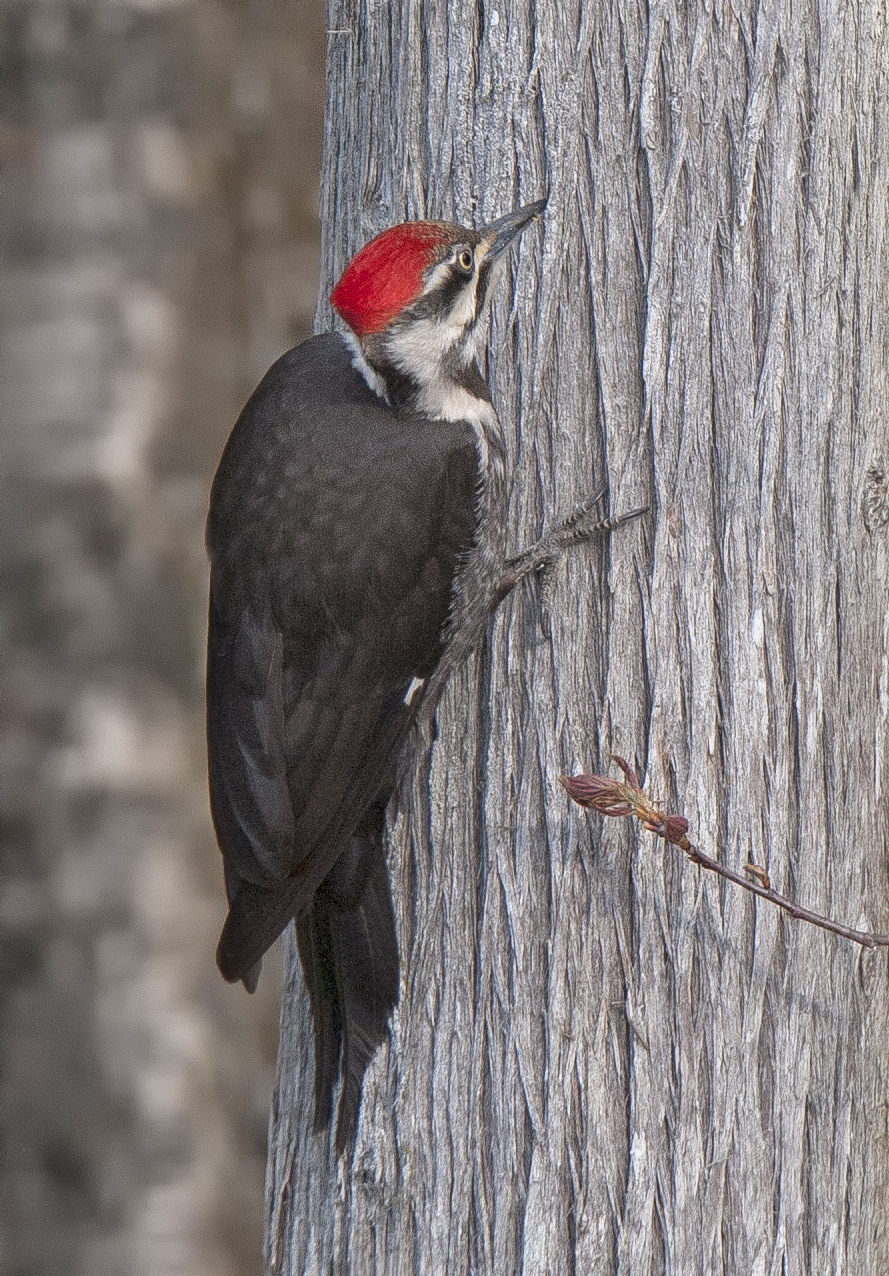
Canadian Bird Species - Pileated Woodpecker

The Pileated Woodpecker is a very large North American woodpecker, roughly crow-sized, inhabiting deciduous forests in eastern North America, the Great Lakes, the boreal forests of Canada, and parts of the Pacific coast. It is also the largest woodpecker in North America.

Adults are 40 to 49 cm (16 to 19 in) long, span 66 to 75 cm (26 to 30 in) across the wings and weigh 250 to 400 g (8.8 to 14.1 oz), with an average weight of 300 g (11 oz). Each wing measures 21.4 to 25.3 cm (8.4 to 10.0 in), the tail measures 14 to 17.4 cm (5.5 to 6.9 in), the bill is 4.1–6 cm (1.6–2.4 in) and the tarsus measures 3.1–3.8 cm (1.2–1.5 in).

They are mainly black with a red crest, and have a white line down the sides of the throat. They show white on the wings in flight. The flight of these birds is strong and direct but has an undulating quality, similar to the relatively unique flight-style of all woodpeckers. Adult males have a red line from the bill to the throat, in adult females these are black.

These birds mainly eat insects, especially carpenter ants and wood-boring beetle larvae. They also eat fruits, nuts, and berries, including poison ivy berries. Pileated Woodpeckers will often chip out large and roughly rectangular holes in trees while searching out insects, especially ant galleries.[4] They also will lap up ants by reaching with their long tongue into crevices. They are self-assured on the vertical surfaces of large trees but can seem awkward while feeding on small branches and vines. Pileated woodpeckers may also forage on or near the ground, especially around fallen, dead trees, which can contain a smorgasbord of insect life. They may forage around the sides of human homes or even cars and can occasionally be attracted to suet-type feeders. Although they are less likely feeder visitors than smaller woodpeckers, Pileateds may regularly be attracted to them in areas experiencing harsh winter conditions.

Usually, Pileated Woodpeckers excavate their large nests in the cavities of dead trees. Woodpeckers make such large holes in dead trees that the holes can cause a small tree to break in half. The roost of a Pileated Woodpecker usually has multiple entrance holes. Pileated Woodpeckers raise their young every year in a hole in a tree. In April, the hole made by the male attracts a female for mating and raising their young. Once the brood is raised, the Pileated Woodpeckers abandon the hole and will not use it the next year. When abandoned, these holes—made similarly by all woodpeckers—provide good homes in future years for many forest song birds and a wide variety of other animals. Owls and tree-nesting ducks may largely rely on holes made by Pileateds in which to lay their nests. Even mammals such as raccoons may use them. Other woodpeckers and smaller birds such as wrens may be attracted to Pileated holes to feed on the insects found in them. Ecologically, the entire woodpecker family is important to the well being of many other bird species. The Pileated Woodpecker will also nest in nest boxes about 4.6 m (15 ft) off the ground.

A Pileated Woodpecker pair stays together on its territory all year round and is a non-migratory species. It will defend the territory in all seasons, but will tolerate floaters during the winter. When clashing with conspecifics, they engage in much chasing, calling, striking with the wings, and jabbing with the bill.

Drumming is most commonly to proclaim a territory and hollow trees are often used to make the largest sound possible.

Pileated Woodpeckers have been observed to move to another site if any eggs have fallen out of the nest—a rare habit in birds. The cavity is unlined except for wood chips. Both parents incubate three to five eggs for 12 to 16 days. There is an average of clutch size of 4 per nest. The young may take a month to fledge. (source for information was Wikipedia)

The Pileated Woodpecker is a species we often see on our Canadian Workshops. Although hard to get a clear photo of, it is always interesting to come across a tree that they have been feeding on and watch them as they fly through the tree canopy’s. Please check out our Canadian workshops here… http://northof49photography.com/photo-workshops/

Monday, June 8, 2015

Mongolia, a visit to the past, so you can understand your future

If you could take a martini shaker and add a dash of vast landscapes of the Gobi, sprinkle in a twist of the snow capped mountains of Bayan-Ölgi and the dramatic gorges and lakes of Khovsgol and then add in the Ger tents of the nomad and the cry of a soaring golden eagle… Shake it all up and top it off with some of the oldest Buddhist temples and ruins, abundant wildlife and legendary hospitality you will find anywhere, and you come up with a recipe for one of the most inviting and beautiful countries in the world.


Since the fall of communism, Mongolia has done just about everything in its power to open itself up to the world. While the old traditions survive and the wild nature is still mostly intact for the adventurous traveler, Mongolia has also reached out to the West for economic and cultural ties.
One of the highest countries in the world, Mongolia is a land of harsh extremes—snowy mountains, wide expanses of grassy steppe, and windswept desert with a people that are inviting and virtually still untouched by major tourism.

About Mongolia
Capital city: Ulaanbaatar (population 1.2 million)
Population: 3 million
Language: Mongolian
Currency: MNT
Time zone: (GMT+08:00) Irkutsk, Ulaan Bataar
Electricity: Type C (European 2-pin) Type E (French 2-pin, female earth)

Best time to visit Mongolia
Mongolia has an extreme continental climate due to its inland location. The best time for traveling is from May to October when the weather is pleasant. Due to the popularity of the Naadam Festival, July is the busiest time to go; it can get crowded, but Ulaanbaatar buzzes with an incredible vibe during this time.

Culture and customs
Mongolia is known for its strong nomadic traditions, but life has recently become more urbanised for many citizens in this sparsely populated country. Almost 50% of the population live in or near an urban centre, while the other 50% live a semi-nomadic lifestyle in the countryside; although, settled agricultural communities can be found in rural areas and are growing each year. Despite this change in lifestyle, the rich nomadic heritage remains strong and traditional Mongol songs, dance, stories and clothing are still celebrated, especially during festivals and national holidays.

Many Mongolian people are Buddhist - this is evident in the monasteries and temples that populate the urban areas as well as the remote regions. Shamanism is also still in existence in some of the more isolated regions of Mongolia where the proud cultures have been somewhat protected from modern influences.

A common thread that links most Mongolians is respect for family and the importance of hospitality.
Probably borne from the nomadic way of life, sharing with others and receiving guests with grace is a common theme that recurs in Mongolian society. Harsh conditions, a changeable climate and the uncertainty of nomadic life mean that most Mongolians go out of their way to provide a safe haven for family, friends and guests. It is for this reason that turning down food or not accepting a warm welcome is not advisable.


Geography and environment
Bordered by China and Russia, Mongolia is a land of mountains and plateaus, grasslands, marshes and deserts. Even though Mongolia is landlocked, Lake Khovsgol (one of Asia’s largest freshwater lakes) provides 70% of Mongolia’s fresh water. This ancient lake provides much of the drinking water for the animal and human population, with the surrounding areas providing lush habitats for wolves, ibex, deer and bears. Due to Mongolia’s significant seismic activity, there are also many hot springs and volcanoes throughout the country.

Mongolia is one of the least densely populated countries in the world, leaving much space for nomadic herders to roam. The fast-growing capital city of Ulaanbaatar is an exception, being home to high-density housing, universities and financial institutions. As an economic centre and transport hub, Ulaanbaatar has all the modern conveniences expected of an international city.

History and government
Early History
The area now known as Mongolia has been inhabited for more than 800,000 years. Archaeological evidence, such as rock paintings, points to groups of hunters and gatherers living throughout Mongolia in prehistoric times. Mongolia’s early history is colored by battles and invasions, with various nomadic empires laying claim to the land. The most famous of these was the Mongol Empire, created by Genghis Khan in 1206. This empire was known as the largest land-based empire of its time and had great success invading and claiming foreign territory, before declining due to infighting, disunity and the rise of neighboring territories.

Recent History
Modern Mongolia is an interesting mix of Mongol, Chinese and Russian influences. Rising up to gain independence from decades of communist rule, modern Mongolia is becoming more fast-paced and globalized as the years go by. Holding its first democratic election in 1990, Mongolia now enjoys a time of relative peace and stability, with tourism, agriculture and mineral resources providing more abundance and improvements in infrastructure and living conditions.

Mongolia is one of the only legitimate democracies in Asia. Democracy has given foreign investors enough confidence to stick with Mongolia during hard biggest mining companies in the world. Tourism, along with mining and cashmere, has become a key feature of the economy. It is true that the poor infrastructure and short travel season have kept receipts small, but a growing network of ger camps cater to travellers seeking ecotourism adventures.
Without fences or private property to restrict a travelers movement, Mongolia is a perfect destination for photography enthusiasts.
Like us, most travelers come for Naadam, the two-day summer sports festival that brings the city of Ulaanbattar to a standstill. But a trip to capture Mongolia’s unique charm will always lie in the countryside where, rather than being a spectator to the wrestling, you may find yourself alone with our groups in some of the most awe inspiring vistas you will ever see.
Outside the villages it’s easy to meet nomad families whose relentless sense of hospitality can at times be nothing short of overwhelming.
As a travel destination, Mongolia is a special place for people who enjoy culture, the outdoors and adventure. Immersing oneself in the Naadam festival, the Golden Eagle Festival and the urban culture and then heading out on the vast plains, riding horses and camping with nomad families, Mongolia offers the chance to step back in time to a simpler way of life. It is an invigorating and exhilarating place to visit, and remains one of the last unspoiled travel destinations in Asia.
I believe that one must first understand our past before we can understand our future… and because I have sat many times with nomadic farmers and eagle hunters that embrace a tradition almost 1000 years old as a way of life, I have gotten a better understanding of their history, and now want to continue to share and photograph their future with you.  
That is why I plan to visit the country every year. To see more information on these trips please check out the itineraries.

Wednesday, June 3, 2015

Canadian Wildlife Spotlight - The Red Fox

 
The red fox (Vulpes vulpes) is the largest of the true foxes and the most abundant member of the Carnivora, being distributed across the entire Northern Hemisphere from the Arctic Circle to North Africa, Central America and Asia. Its range has increased alongside human expansion, having been introduced to Australia, where it is considered harmful to native mammals and bird populations. Because of these factors, it is listed as Least Concern by the IUCN.

The red fox originated from smaller-sized ancestors from Eurasia during the Middle Villafranchian period, and colonised North America shortly after the Wisconsin glaciation. Among the true foxes, the red fox represents a more progressive form in the direction of carnivory. Apart from its large size, the red fox is distinguished from other fox species by its ability to adapt quickly to new environments.

Red foxes are usually together in pairs or small groups consisting of families, such as a mated pair and their young, or a male with several females having kinship ties. The young of the mated pair remain with their parents to assist in caring for new kits. The species primarily feeds on small rodents, though it may also target leporids, game birds, reptiles, invertebrates and young ungulates. Fruit and vegetable matter is also eaten sometimes. Although the red fox tends to kill smaller predators, it is vulnerable to attack from larger predators, such as wolves, coyotes, golden jackals and medium- and large-sized felines.

The species has a long history of association with humans, having been extensively hunted as a pest and furbearer for centuries, as well as being represented in human folklore and mythology. Because of its widespread distribution and large population, the red fox is one of the most important furbearing animals harvested for the fur trade.

Red foxes are the largest species of the genus Vulpes. However, relative to dimensions, red foxes are much lighter than similarly sized dogs of the genus Canis. Their limb bones, for example, weigh 30% less per unit area of bone than expected for similarly sized dogs. They display significant individual, sexual, age and geographical variation in size. On average, adults measure 35–50 cm (14–20 in) high at the shoulder and 45 to 90 cm (18 to 35 in) in body length with tails measuring 32 to 53 cm (13 to 21 in). The ears measure 7.7–12.5 cm (3–5 in) and the hind feet 12–18.5 cm (5–7 in). They weigh 2.2 to 14 kg (4.9 to 30.9 lb), with vixens typically weighing 15–20% less than males. Adult red foxes have skulls measuring 129–167 mm (5.1–6.6 in), while those of vixens measure 128–159 mm (5.0–6.3 in).[6] The forefoot print measures 60 mm (2.4 in) in length and 45 mm (1.8 in) in width, while the hind foot print measures 55 mm (2.2 in) long and 38 mm (1.5 in) wide. They trot at a speed of 6–13 km/h, and have a maximum running speed of 50 km/h. They have a stride of 25–35 cm (9.8–13.8 in) when walking at a normal pace. North American red foxes are generally lightly built, with comparatively long bodies for their mass and have a high degree of sexual dimorphism.

The winter fur is dense, soft, silky and relatively long. For the northern foxes, the fur is very long, dense and fluffy, but is shorter, sparser and coarser in southern forms. Among northern foxes, the North American varieties generally have the silkiest guard hairs, while most Eurasian red foxes have coarser fur. There are three main colour morphs; red, silver/black and cross (see Mutations). In the typical red morph, their coats are generally bright reddish-rusty with yellowish tints. A stripe of weak, diffuse patterns of many brown-reddish-chestnut hairs occurs along the spine. Two additional stripes pass down the shoulder blades which, together with the spinal stripe, form a cross. The lower back is often a mottled silvery colour. The flanks are lighter coloured than the back, while the chin, lower lips, throat and front of the chest are white. The remaining lower surface of the body is dark, brown or reddish. During lactation, the belly fur of vixens may turn brick red. The upper parts of the limbs are rusty reddish, while the paws are black. The frontal part of the face and upper neck is bright brownish-rusty red, while the upper lips are white. The backs of the ears are black or brownish-reddish, while the inner surface is whitish. The top of the tail is brownish-reddish, but lighter in colour than the back and flanks. The underside of the tail is pale grey with a straw-coloured tint. A black spot, the location of the supracaudal gland, is usually present at the base of the tail. The tip of the tail is white - information supplied from Wikipedia

We ran into a Fox den this year on our sprint migration and young wildlife workshop in Ontario this year. The den was home to seven (7) kits.

I hope you join us next year on our annual spring migration workshop. All the details can be found here. http://northof49photography.com/ontario-migration-workshop

Sunday, March 22, 2015

Photography Tour and Workshp Leader, Kevin A. Pepper

Introducing Kevin A. Pepper - K2. Kevin is the owner and Co-Founder of North of 49 Photography

Kevin A. Pepper is a Sigma PRO photographer and Manfrotto Ambassador based in Waterloo, Ontario, Canada. For the past three years he has been teaching photography to enthusiasts here in Canada and around the world.

His first love is photographing nature, regardless of the season or weather condition; the Canadian landscape and wildlife are his inspiration. But you will also see other styles of photography in his portfolio. From street photography to urban exploration of abandoned buildings and architecture, he loves to capture it all with his camera for his corporate clients and his growing personal portfolio.

Kevin’s images have been featured in Canadian Nature Photographer, PHOTONews Canada, Henry's Camera Store, Photo Technique Magazine, Quebecor Media, The Weather Network and National Geographic Online. His work has also been used by companies such as the City of Cambridge, Olympus, GORE Mutual, TVO and African Lion Safari.


Kevin runs Photo Tours and Workshops across Canada, into Africa and different parts of Asia. The trips that he has years of experience running are in Mongolia, across Yukon, Northwest Territories and the east coast of Canada. 

To see all the tours and workshops Kevin is leading, see this link here, http://northof49photography.com/kevin-a-pepper-tours

To read what clients have said about the trips Kevin has ran, please see this link, http://northof49photography.com/testimonials

To see his personal website: www.kevinpepperphotography.com